3 Neurotherapy Books Worth Reading
The following three books have been chosen for their mix of theory and practice, accessible language, and case study illustrations.
1. Neurofeedback 101: Rewiring the Brain for ADHD, Anxiety, Depression and Beyond (without medication) – Michael P. Cohen
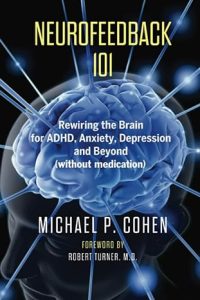
Michael P. Cohen is the director of neurotechnology at the Center for Brain Training, one of the largest neurofeedback practices in south Florida. He has specialized in neurofeedback since 1996 and trains health professionals in neurofeedback for clinical practice.
Neurofeedback 101 is an introductory text on neurofeedback for laypeople and clinicians alike.
It may be especially useful for sharing with potential clients. The book explains what neurofeedback is in simple, clear language, how it works, and what it can achieve. It uses real-life examples to illustrate how neurofeedback helps both kids and adults with their symptoms.
Find the book on Amazon.
2. Neurofeedback in the Treatment of Developmental Trauma: Calming the Fear-Driven Brain – Sebern F. Fisher
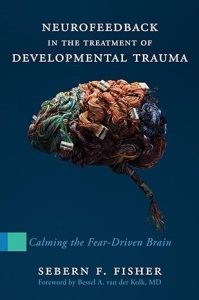
International trauma expert Bessel van der Kolk wrote the foreword to this book by psychotherapist Sebern Fisher, calling her “an immensely experienced neurofeedback practitioner [and] the right person to teach us how to integrate it into clinical practice” (Fisher, 2014, xi).
Developmental trauma results from ruptures in a child’s ability to attach to a primary caregiver safely and can cause a range of complex symptoms, including emotional dysregulation, dissociation, self-harm, and social isolation, all underpinned by a bedrock of fear.
Fisher’s book explains how neurofeedback can help treat developmental trauma, including severe childhood abuse, neglect, and abandonment.
Theory and practice are combined to explain how neurofeedback can retrain the brain and regulate a traumatized nervous system. Fisher describes how neurofeedback can help stabilize attention, regulate emotion, and reduce fear over time.
The book also covers the clinical skills required to provide neurofeedback, including how to introduce it to clients, how to perform assessments, and how to combine neurofeedback sessions with traditional talking therapies.
Find the book on Amazon.
3. Neurotherapy and Neurofeedback – Theodore J. Chapin and Lori A. Russell-Chapin
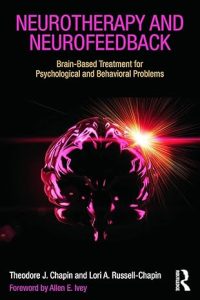
In Neurotherapy and Neurofeedback, Lori Russell-Chapin and Theodore Chapin draw on their clinical and scholarly expertise to explain advances in neurobiology and neuropsychology and introduce the growing body of research in the field.
The book explores the neuroscience of the human brain and its ability to develop new neurons and neuronal pathways in response to fresh challenges across the lifespan, which amounts to the brain “rewiring” itself.
The authors describe how neurofeedback trains the brain to self-regulate, which is an intrinsically rewarding activity that enhances executive function.
Readers learn how brain dysregulation occurs and the kinds of interventions available when medication and talking therapies fail to alleviate psychological suffering.
Find the book on Amazon.
A Take-Home Message
Neurofeedback, or neurotherapy, is a non-pharmacological treatment for a range of conditions that result in unusual brain wave patterns and a dysregulated nervous system.
During treatment, a neurofeedback loop is established between the brain and the audio–visual stimulus on the screen that the brain gradually recognizes as its own activity. This feedback loop triggers the release of small amounts of dopamine in the brain and is inherently pleasurable. Therefore, the entire brain training cycle is self-reinforcing because it is intrinsically rewarding.
Further research is needed to establish treatment efficacy in large-scale RCTs that are properly controlled. These would also uncover any side effects that may be missed in small-scale studies.
At present, neurotherapy is offered to veterans with PTSD for free across the United States. Research shows it is an effective treatment for trauma that avoids the pitfalls of other treatments, such as medication compliance and side effects, and the triggering of traumatic memories in talking therapy.
We hope you enjoyed reading this article. Don’t forget to download our five positive psychology tools for free.



 There is increasing recognition that unresolved trauma underpins many mental health problems.
 Biofeedback tracks the metabolic processes of the entire human organism, with the aim of regulating the
  Neurofeedback certification was introduced as a voluntary self-regulation process to set professional standards of care and to satisfy health care insurance providers.