Research on Mindfulness and Creativity
Research indicates that 47% of the time, we do not think about what is happening in the present moment. Additionally, a wandering mind has been linked to greater unhappiness, regardless of whether the mind wanders to pleasant or unpleasant thoughts (Killingworth & Gilbert, 2010).
From its early beginnings in the teaching of Buddhism more than two millennia ago, the concept of mindfulness migrated to the West and saw considerable increases in popularity by the 1950s and 1960s. Many artists and psychology professionals of these decades became interested in Eastern schools of thought and philosophy, with some practicing Buddhism themselves and others simply being intrigued by its concepts.
Jung (1965) believed mandalas had a soothing effect and observed that mandala-type images repeatedly appeared in the drawings of the mentally ill. The drawing of mandalas was often incorporated into the treatment of his clients.
Singer (1994) described a case in which mandala drawing was deemed critical to the successful treatment of a patient experiencing distress from recurring dreams.
The individual experienced difficulties when attempting to verbally express the emotions he was experiencing or the impact the dreams were having on his day-to-day life. He was asked to draw pictures in the form of mandalas and in a short period of time began engaging in verbal associations between what he had drawn and the dreams that troubled him.
More recently, new art therapy practices have emerged, such as Mindfulness-Based Art Therapy (MBAT) and Mindfulness Exploration of Art Materials (MEAM). MBAT is a growing form of art therapy that combines art therapy exercises with a curriculum drawn from multiple programs designed to increase mindfulness.
Peterson (2010) investigated the use of MBAT and MEAM exercises and discovered that reflective explorations of art materials assisted in the development of mindfulness. In this study, participants were asked to hold a sheet of paper in their hands and describe what they felt, to bring a pencil to their nose and describe what they could smell. That is to say, they were asked to pay deliberate attention to the experience of interacting with each art material.
Agnoli, Vanucci, Pelagatti & Corazza (2018) examined mind-wandering and mindfulness in relation to creativity. Mindfulness was analyzed by distinguishing five different constitutional dimensions:
- observing,
- acting with awareness,
- describing,
- non-reactivity, and
- non-judging.
Results indicated that spontaneous mind-wandering (experiencing unintentional engagement of unguided thoughts) decreased the likelihood of creative performance, whereas deliberate mind-wandering (an effortful, intentional engagement of unguided thoughts) positively predicted creative performance.
Furthermore, it was suggested that deliberate mind-wandering and mindfulness predicted creative behavior, both alone and in combination, suggesting a complex interdependence between the two within the creative thinking process.
What is Mindfulness Coloring?
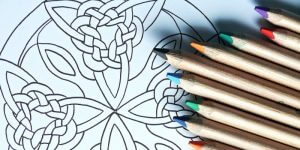
As we search for ways to cultivate mindfulness, there is an almost innate understanding that engagement with the arts is a valuable route to take.
One example of this phenomenon is seen in the increasing interest in mindfulness coloring.
Mindfulness coloring has become a niche market, with adult coloring books accounting for an almost 7% increase in adult nonfiction book sales in 2015 (Milliot, 2016). Unlike the coloring books of your childhood, mindfulness coloring books are often more abstract, require more dexterity, and contain calming illustrations with intricate patterns (Barrett, 2015).
The fundamental concept of mindfulness coloring is that the very act of coloring pre-drawn illustrations provides an opportunity to suspend our inner dialogue and engage in an activity that disregards the flow of negative thoughts that can dominate our lives.
Not to be confused with art therapy which is facilitated by a qualified therapist, mindful coloring is designed to provide an opportunity to spend time in a focused state, undertaking a creative activity that can have a calming, meditative effect.
Carl Jung is credited as being one of the first to pioneer this use of coloring as a form of meditative therapy. His focus was on the drawing and coloring of mandalas – circular designs with concentric shapes – which represent wholeness in ourselves, and in the universe.
Taking part in enjoyable activities to de-stress is not a new concept. We live in a stress-inducing world in which we are constantly exploring new ways to improve mindfulness and restore feelings of wellbeing. Coloring is just one of the increasingly varied ways in which we can pursue mindfulness.
Why Mindful Coloring Works
Traditional mindfulness techniques focus the mind in order to promote the self-regulation of attention. Through meditation, a state of relaxation can be achieved by focusing on the present and blocking out external distractions. Mindfulness coloring is no different.
As with meditation, mindfulness coloring allows us to switch off extraneous thoughts and focus on the moment. It has long been recognized within both Jungian and transpersonal psychology that self-expression through artistic, visual means can be potentially therapeutic (Mellick, 2001).
Curry and Kasser (2005) indicated that the positive effects of mindfulness coloring occurred when there was a challenge-skills balance. An image which is complex and structured enough that it requires a certain amount of attention to complete, is significantly more effective than one which is too simple or complex that it requires excessive thought or focus.
If anxiety is a type of ‘inner chaos’ (Grossman, 1981), it seems likely that a structured activity such as coloring a predetermined, complex design would help to organize that chaos.
In the same study, it was noted that individuals who took part in free-form coloring – with no image to color, just a blank page – stopped periodically to tap a pencil, look around, and to consider what to color next.
This suggested that complex, structured designs draw us into a meditative-like state while participants who decided what to draw for themselves may have experienced too many distractions and confusion about what to draw or color next.
Much like other mindfulness activities, coloring directs our conscious attention away from ourselves and into the present moment. Bea (2015) stated that the focus of thoughts on a simple activity like coloring tends to relax the brain, thereby negating disturbances from our own thoughts and potentially negative self-appraisals.
22 Free PDF Printable Coloring Pages
 Developed by psychologist, Dr. Lawrence Shapiro, this collection of nine mindful coloring illustrations ranges in difficulty and complexity.
Beginning with some useful information about mindfulness and advice on how to approach your coloring in a mindful way, the varied images are sure to keep your mind focused.
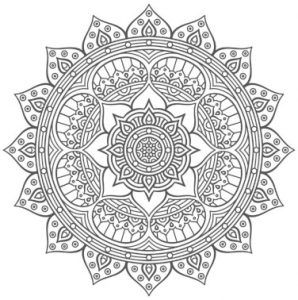
This intricate and detailed Swirling Leaves Mandala is complex enough that coloring will take some time.
Created as a mindfulness resource to give children the opportunity to learn awareness in the moment and reflect on their feelings and thoughts, the following collection of free PDFs is also great for beginners. Twelve animals are available, including an elephant, dragonfly, fox, iguana, rhino, and turtle.
7 Mindfulness Coloring Books
The wealth of mindfulness coloring books currently available ensures the choice available won’t be reminiscent of the books you remember as a child. These intricately designed books have been created specifically to help you focus your mind.
The choice of media depends on your personal preferences: crayons, colored pencils, marker pens or watercolor pens. Fine-point pens or colored pencils are a good place to begin, as they are easy to use and have a nice point for more intricate areas. Remember, there are no rules for coloring and no need for perfection
The following mindfulness coloring books were chosen for their structured yet creative illustrations. This list is by no means exhaustive, more a guide to get you started and to demonstrate that there is something out there for everyone to enjoy.
1. Stress Less Coloring: Mandalas
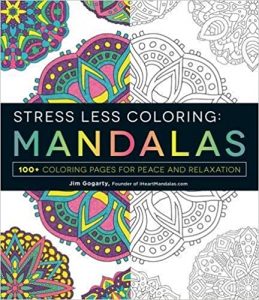 Much contemporary art therapy literature promotes the coloring of mandalas as a method of alleviating stress and anxiety, and improving mood (Mantzios & Giannou, 2018).
The Stress Less Coloring: Mandalas is a collection of 100 geometric mandala designs for you to color while you concentrate on the details and quieten the mind.
Available from Amazon.
2. Colour Yourself Calm
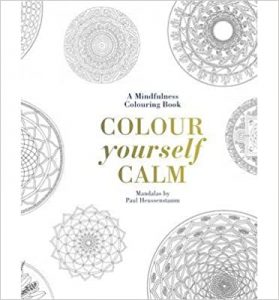 The Colour Yourself Calm: A Mindfulness Colouring Book includes a beginner’s guide to practicing simple mindfulness techniques whilst coloring.
The book consists of double-page spreads of full-color mandalas with a black outlined copy of the image on the adjoining page for you to add color to as you wish.
Coloring the symmetrical form of the mandala with its repeating patterns and complexity purportedly helps draw us into a state similar to meditation (Chaudhary, 2012).
Available from Amazon.
3. Earth and Space Coloring Book
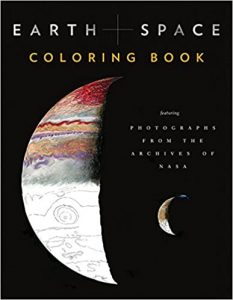 The Earth and Space Coloring Book includes photographs from the NASA archives with an adjoining illustration of the same image for you to color.
This book features images taken from the Hubble telescope ranging from views of Earth, Jupiter and Saturn to beautiful star clusters, nebula, and supernovae.
The intricate, detailed illustrations will require a certain amount of attention to complete.
Available from Amazon.
4. Modern Meditation: Coloring For Focus and Creativity
 Modern Meditation: Coloring For Focus and Creativity by psychologist Stan Rodski contains more than 75 unique patterns designed to focus your brain through pattern, repetition, single focus, and creativity.
Specializing in neuro-scientific research, Rodski draws inspiration from the study of neuroscience to guide you through this mindfulness coloring activity.
Available from Amazon.
5. Enchanted Forest: An Inky Quest and Coloring book
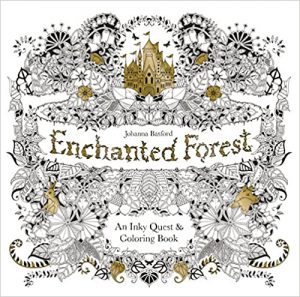 Enchanted Forest: An Inky Quest and Coloring book is primed for coloring – including the front cover.
The intricate, hand-drawn flora and fauna illustrations take you on a fun journey through an imaginary enchanted land.
The delicate designs invite you to peer closer and discover the hidden intricacies within each illustration.
Available from Amazon.
6. Just Add Color: Mid-Century Modern Animals
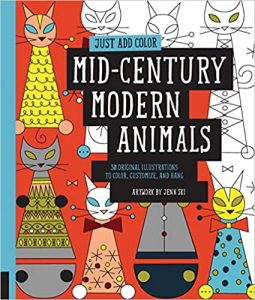 Just Add Color: Mid-Century Modern Animals is a little bit different.
Consisting of mid-20th century-inspired designs, artist and illustrator Jenn Ski has created a book that is a lot of fun.
Packed full of quirky illustrations with a retro twist, the illustrations lend themselves to complete freedom of imagination. The handy perforated pages mean you can easily frame and hang your masterpiece.
Available from Amazon.
7. Mindfulness Coloring Book for Children
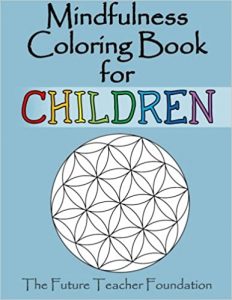 The Mindfulness Coloring Book for Children is a great way to introduce mindfulness to children.
This book consists of simple shapes and patterns designed to enhance concentration skills and mindfulness.
Each image is single-sided and easily removed from the book, meaning it can be framed and displayed with pride.
Available from Amazon.
Finding Mindfulness Through Drawing
In mindful drawing, the principles of mindfulness are applied to mark-making. A mindful drawing exercise is one that helps bring attention to the present by focusing on what you are drawing and using all the senses, not solely what you see.
Greenhalgh (2016) described the practice of mindfulness through drawing as one in which you lose yourself to the movement of your pencil gliding across the page, the coordination of eye and hand, and the observation of the object being studied and drawn.
Mindfulness drawing can be structured in one of two ways, the first being to doodle without plan or purpose. Drawing, shading, and coloring in whatever way feels pleasant, affords an opportunity to learn more about ourselves. There is no right or wrong way to doodle, it’s all about drawing what you feel and exploring your creativity.
The second and most fruitful way is to draw from real life. Life drawing requires more conscious concentration and observation of what we really see – not what we think we see (Grant, Langer, Falk, & Capodilupo, 2011). Forget what you think a face, a hand or a leaf looks like, and really pay attention to it before making a mark on the paper.
Change the angle at which you look at a flower, for example, do you notice anything different from this new perspective? You might, for the first time, really see the texture of the petals, the subtle variations in their color. By taking time to slow down and observe you will undoubtedly notice those tiny details you never noticed before.
By letting go of pre-conceived ideas, we can start to see things as they truly are. Some artists say that you never really see a person until you draw them. It’s certainly true that drawing from real life can open your eyes to a whole world of detail that you never noticed before.
There are some steps you can take to ensure your drawing experience is a mindful one:
- It is important that you stay in the present moment and remain non-judgmental about your own abilities. Avoid thinking about previous experiences, telling yourself that you can’t draw and thinking too much about the end result will take you out of the moment.
- Being non-critical can be difficult, but the absence of judgment is an intrinsic part of mindful practice.
- Think outside the box. There are many techniques that can encourage more abstract creative thinking. Drawing using only straight lines, with the pencil never leaving the paper, or using dots instead of traditional shading techniques will add a new dimension to drawing that can help improve focus.
- Before you put pencil to paper, sit quietly for a few minutes and observe the space around you and the object you intend to draw. How does it feel in your hands? Try to look at it in a way you haven’t before. What do you see that you have never noticed before?
- Remember, there is no right or wrong way to draw. The end result isn’t the primary goal with mindful drawing; rather it is the process of focused drawing that is most important.
What is a Mindfulness Jar?
 Throughout the history of psychology, as with any science, metaphors have proved an invaluable way of connecting the unknown to the known.
The mindfulness jar is no different.
Symbolizing how one’s mind looks and feels when it is full, busy, and unfocused compared to when one is mindful and self-aware, the mindfulness jar is an excellent analogy to explain the unfocused mind.
You have most likely shaken a snow globe until a little tornado of snowflakes begins to swirl around inside. Have you ever watched it until the flakes settle back down to the bottom?
By comparing our own thoughts and emotions to the chaotic snow inside the globe, we can better understand that just as the globe becomes settled and clear again, so too will the mind.
Designed to soothe and relax, the swirling patterns created by the colors and glitter in mindfulness jars have proved beneficial for both children and adults, assisting with a whole range of issues from anger control to anxiety.
Coholic (2011) introduced the mindfulness jar to children as a means of improving self-awareness and resilience. Using a glass jar half-filled with water, the children were asked to assign a thought or feeling to colored beads, then add them one-by-one to the jar.
When each child had added a bead, they were encouraged to shake the jar, look at the contents and concentrate on what they were doing, then pass it on to the next child when the beads had settled. The discussion that followed compared the swirling chaotic contents to an over-stimulated mind.
This visual aid can help explain how the mind is affected by negative emotions like anger or frustration. When the jar is unshaken, the contents peacefully remain at the bottom. When shaken the jar represents the muddled thoughts that prevent us from thinking clearly.
The mindfulness jar is an effective way to orient mindfulness by encouraging a greater awareness of what we are feeling, thinking and doing in the present moment. It can also be of great assistance to controlled meditative breathing. While you watch the contents settle, take deep, calming breaths – experience each inhale and exhale as it happens.


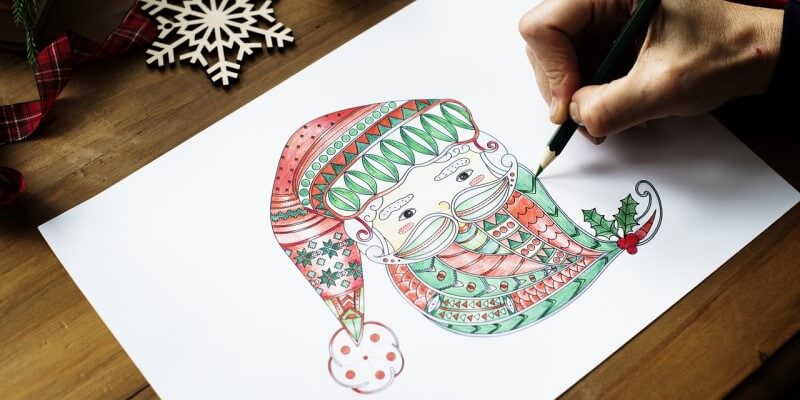
 In the hustle and bustle of modern life it is more important than ever to find ways to become attuned to our inner state and what is happening around us.
 It may come as no surprise to those who already engage in artistic pursuits that practicing mindfulness through art has a multitude of benefits and positive outcomes.
 The traditional paper-folding process known as origami has been a part of Japanese culture since the 6th century.
 The tradition of counting down the days until Christmas is thought to date back to 19th century Germany when candles were lit to observe the days throughout December.