The Importance of Mental Toughness for Young Athletes
Mental toughness offers many advantages. While difficult to fully define, it provides insights into why we respond the way we do to life events and how we perform at our limits (Strycharczyk et al., 2021).
Give two people the same situation, and each will respond differently.
Mental toughness is essential because it helps us be the best possible version of ourselves, lead a productive and contented life, and strive toward our goals — making it a core focus of sports psychology interventions aimed at young athletes (Loehr, 1986).
Mental toughness is also central to how we deal with potentially stressful situations. As such, it is vital for young athletes to cope with tough training and fierce competition combined with academic challenges (Kremer et al., 2019; Rigoni, 2013).
For young athletes, it can boost perseverance in training (even reducing the time to fatigue), provide an edge in competition, and support a healthy life outlook, improving self-esteem, optimism, and self-efficacy; lowering anxiety; and increasing life satisfaction (Strycharczyk et al., 2021).
Mental toughness can be the psychological factor separating a winner from a loser in sports. A 2019 review suggests that it ranks top among Olympians when determining successful performance and outcomes (Liew et al., 2019).
Interventions targeting elements of mental toughness have been shown to benefit athletes’ performance and competitive edge alongside their psychological and physical wellbeing and offer support for consistent training and competition outcomes (Bell et al., 2013; Strycharczyk et al., 2021).
A 2021 research paper explored mental toughness in US collegiate athletes and found that while building mental toughness increased wellbeing, it also reduced stigma toward help seeking (Bird et al., 2021).
Beyond Resilience: 4 Key Components of Mental Toughness
 Resilience is not simply bouncing back from difficult events, obstacles, and challenges. Instead, it’s about finding a new path — the right one — that takes the individual forward in line with new values, beliefs, and dreams (Neenan, 2018).
While resilience is a psychological term for getting back on track, mental toughness is more focused on the “ability to cope with the demands of training, competition, and lifestyle, whilst remaining more consistent, attention focused and controlled under pressure” (Sutton, 2019, p. 24).
Top athletic performers must have self-belief, desire, and motivation, along with the capacity to deal with pressure and anxiety, and these are shaped by early environmental factors, parenting, the competitor’s mindset, and sporting experiences (Sutton, 2019).
Building on the work of earlier researchers such as Jim Loehr (1986), researchers Lee Crust and Peter Clough (2005) defined “mental toughness as a trait-like dimension of personality, made up of four psychological attributes, control, commitment, challenge and confidence” (Sutton, 2019, p. 96).
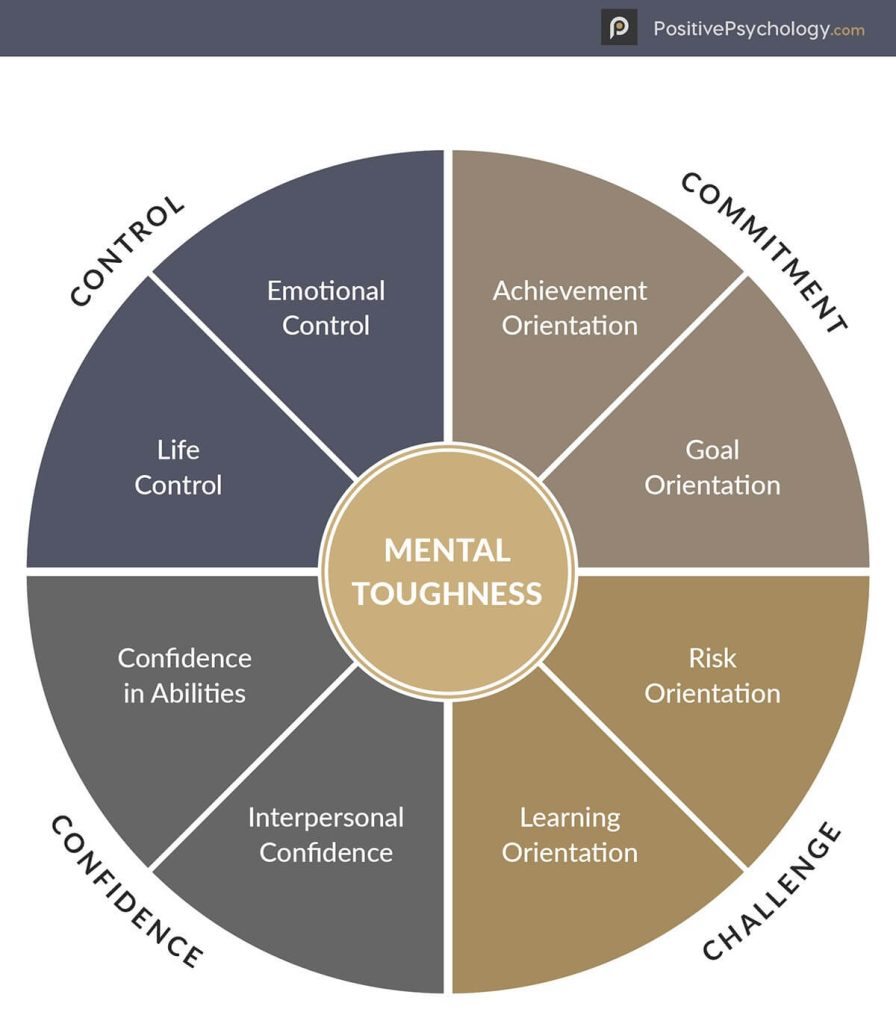



 Mental toughness is not about being the loudest and brashest athlete on the sports field, pitch, track, or in the pool.
 Support from coaches and parents is vital to developing and maintaining mental toughness in young athletes (Strycharczyk et al., 2021).
 The literature identifies many techniques that build mental toughness and resilience in young athletes. Here are four (Strycharczyk et al., 2021):