A Note on Cognitive Dissonance in Relationships
Cognitive dissonance and the way we cope with it regularly affect our relationships, too, both positively and negatively.
Relationships are typically built on shared attitudes, beliefs, and values. When our friends or partners act contrary to our beliefs and values, we perceive dissonance.
Coping mechanisms can include justifying their behavior (and our relationship with them), trivializing their behavior or the importance of it, attempting to change their behavior, or changing our own behavior.
This offers opportunities to discuss the discrepancies, deepen the relationship, and re-align values. Conversely, we may justify or trivialize negative behavior or even end the relationship.
In romantic relationships, important values represent hotspots for cognitive dissonance and typically center on big decisions, such as the wish to have children, lifestyle choices (e.g., buying a house vs. traveling the world), and issues related to family and friends.
The expectation of shared beliefs, values, and attitudes from family members can additionally influence romantic relationships. If these don’t align, we might consider justifying our relationship or breaking up. An extreme example of the negative consequences of cognitive dissonance is when we justify our partner’s harmful behavior toward us and get stuck in a toxic relationship.
2 Books on the Topic
1. A Theory of Cognitive Dissonance – Leon Festinger
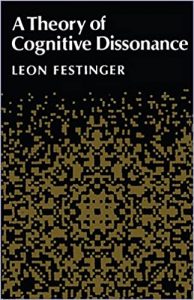
The original book by Leon Festinger is a staple on every (social) psychologist’s bookshelf.
It provides an introduction to the theory and covers the topics of cognitive dissonance following decisions, the effects of forced compliance, the impacts of voluntary and involuntary exposure to information, and the role of social support.
Find the book on Amazon.
2. Cognitive Dissonance: 50 Years of a Classic Theory – Joel Cooper
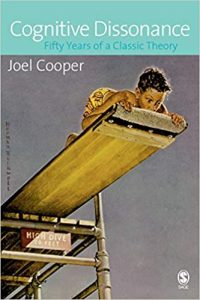
Psychologist Joel Cooper recently published a comprehensive update of cognitive dissonance theory after more than 50 years of research.
This book includes examples of cognitive dissonance in today’s world.
Find the book on Amazon.
4 Interesting Podcast Episodes on the Subject
The Psych Files is hosted by psychologist Dr. Michael A. Britt and has several episodes on cognitive dissonance:
- Episode 8: Cognitive Dissonance Theory: Why Contradictions Bother Us So Much
- Episode 10: Cognitive Dissonance Strikes Again! What Your Search on Amazon Says About You
- Episode 63: Cognitive Dissonance, the Monty Hall Problem and a Possible Resolution?
This episode of the podcast Behavioral Grooves features an interview with Dr. Kathleen Vohs on cognitive dissonance theory. Dr. Vohs discusses the topic as it relates to supporters of Former President Donald Trump justifying one of his controversial tweets in 2019.



 “Tomorrow I will start my diet,” I reflected, while munching a doughnut.
 Cognitive dissonance is not necessarily a bad thing.
 According to psychology professor Joel Cooper (2007), “Most therapies seek to change people’s maladaptive reactions to their social world to more adaptive responses.”